The Blog for Analog Photography
Analog photography is a deliberate process of visual composition, film development, and craftsmanship. On this blog, I share experiences, techniques, and thoughts on analog photography — from camera equipment to darkroom work to individual image stories. Choose a category or scroll down for the latest articles.

Why I believe there is no such thing as 'analog aesthetic'.
Hardly any term comes up as often in the world of analog photography as "analog aesthetics." Many photographers associate it with a certain look: images seem to them more organic, more timeless, or more authentic than digital shots. But what exactly lies behind this term? Is it actually due to technical properties of the film—grain, tonal gradation, color rendition? Or is it more of an emotional perception, shaped by the conscious process of shooting on film, by our memories of past visual worlds, and by the history of photography itself?
In the summer of 2015, I visited the Amerika Haus in Berlin, where Sebastião Salgado was presenting his project "Genesis"…
Read more
Why Shadows Matter More Than Highlights in Black-and-White Films
If you only take away one rule from this article, make it this one:
Expose for the shadows, develop for the highlights.
Why this works—and why film behaves fundamentally differently from a digital sensor—is explained in the rest of this article, including the characteristic curves behind it and a practical example at the end.
Every light-sensitive medium—whether a digital sensor or photographic film—can be described by a characteristic curve: a graph showing how much output signal (image brightness) is produced for a given amount of incoming light. The fundamental difference between a digital sensor and film lies in the shape of these curves.
Read more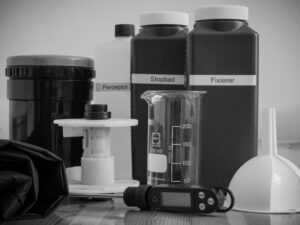
What You Really Need to Develop Your First Film Yourself
Have you ever experienced this?
It's Friday afternoon, and you're back at the drugstore for the second time this month. You drop off a roll of film, pay ten euros for development and scanning, and a few days later the images arrive. The quality is decent at best, but often fairly inconsistent.
The alternative is to mail the film to a professional lab, wait about a week, and pay closer to thirty euros—this time for noticeably better results.
In the end, every roll costs somewhere between ten and thirty euros, depending on how much the improved quality is worth to you.
At some point, the obvious thought occurs:
Surely I could do this myself.
And just as quickly…
Read more